Ключевые выводы
- First 30 years: Registered at the Land Department. Fully protected by law.
- Second 30 years (first renewal): A contractual option written into the lease agreement.
- Third 30 years (second renewal): Another contractual option.
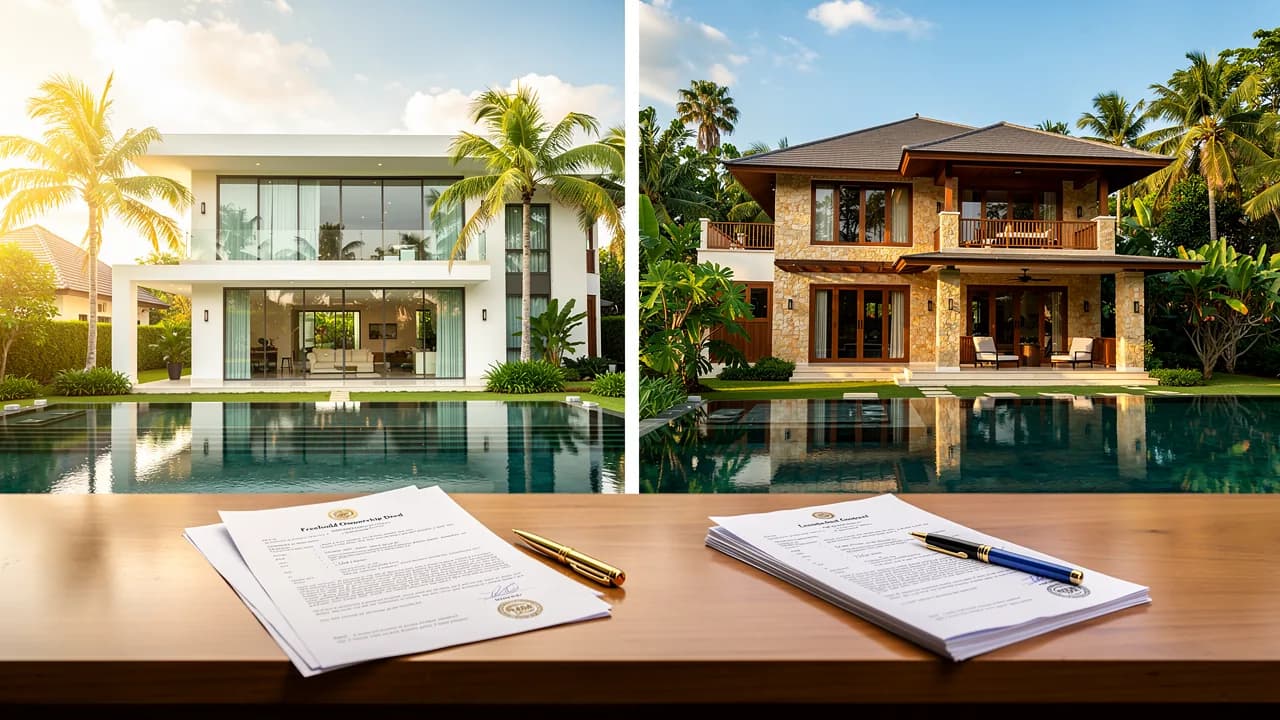
A detailed comparison of freehold and leasehold property ownership in Phuket for foreign buyers: legal differences, costs, resale value, risks, and practical advice for 2026.
Choosing between freehold and leasehold ownership is one of the most important decisions any foreign buyer faces in Phuket. Each structure has distinct legal implications, cost profiles, and long-term considerations. This guide breaks down everything you need to know to make the right choice for your situation in 2026.
Legal Definitions Under Thai Law
Freehold (Grammaisit)
Freehold means absolute ownership with no time limitation. The owner's name appears on the title deed (chanote) issued by the Land Department, and the owner has full rights to use, sell, lease, mortgage, or bequeath the property.
For foreigners in Thailand, freehold ownership is only available for condominium units under the Condominium Act B.E. 2522. The law allows foreign nationals to own condo units provided that total foreign ownership in any given condominium building does not exceed 49% of the total sellable area.
Freehold ownership is perpetual — it does not expire, and it passes to your heirs upon death.
Leasehold (Sittikarnchao)
Leasehold is a time-limited right to possess and use a property. Under Thailand's Civil and Commercial Code (Sections 537-571), the maximum registrable lease term is 30 years. A lease exceeding 3 years must be registered at the Land Department to be enforceable against third parties.
Leasehold is the primary structure used by foreigners to control villas, houses, townhouses, and land in Phuket. The leaseholder does not own the property but has exclusive rights to use it for the lease term.
The 30+30+30 Leasehold Structure Explained
Since Thai law caps registered leases at 30 years, developers and sellers commonly offer an extended structure:
- First 30 years: Registered at the Land Department. Fully protected by law.
- Second 30 years (first renewal): A contractual option written into the lease agreement.
- Third 30 years (second renewal): Another contractual option.
This gives a total of 90 years of potential use. However, there are critical distinctions:
What is legally guaranteed:
- Only the initial 30-year registered lease is enforceable as a property right.
- During this period, even if the landowner sells the land, your lease remains valid and binding on the new owner.
What is contractual (not guaranteed by statute):
- The renewal options are contractual promises between you and the current landowner.
- If the landowner dies, becomes incapacitated, or the land changes hands in certain ways, enforcement of renewal options becomes more complicated.
- Thai courts have generally upheld well-drafted renewal clauses, but there is no absolute statutory guarantee.
How to strengthen a 30+30+30 lease:
- Have the lease drafted by an experienced Thai property lawyer
- Include specific renewal terms, conditions, and penalties for non-renewal
- Register a superficies right (right to own buildings on the land) in addition to the lease
- Ensure the lease is properly registered at the Land Department
- Consider having the landowner issue an irrevocable power of attorney for renewal registration
Freehold vs Leasehold: Direct Comparison
| Factor | Freehold | Leasehold |
|---|---|---|
| Duration | Perpetual (forever) | 30 years registered (+30+30 contractual) |
| Available for | Condos only | Villas, houses, land, and condos |
| Property types | Apartments in registered condominiums | Any property type |
| Title document | Chanote (title deed) in your name | Registered lease agreement |
| Resale | Simple — same as selling any property | Buyer takes over remaining lease term |
| Bank financing | Possible (limited options for foreigners) | Very difficult to finance |
| Inheritance | Passes to heirs (subject to 49% quota) | Depends on lease terms |
| Foreign quota | Must be within 49% foreign limit | No quota restrictions |
| Price premium | 10-20% higher than leasehold equivalent | 10-20% lower than freehold equivalent |
| Registration | Ownership registered at Land Dept | Lease registered at Land Dept |
When Freehold Is the Better Choice
You Want Maximum Security
Freehold condominium ownership is the most legally secure form of foreign property ownership in Thailand. Your name is on the title deed, your rights are clearly defined by statute, and enforcement is straightforward.
You Plan to Resell
Freehold properties are significantly easier to resell. Future buyers — both Thai and foreign — prefer freehold, and you avoid the "diminishing lease" problem where a leasehold property becomes less attractive as the remaining term decreases.
You Want a Low-Maintenance Investment
Condos in managed developments offer hassle-free ownership with professional management, security, pools, and common facilities. For pure rental investment, a well-located freehold condo in a managed resort is hard to beat.
You Want to Finance the Purchase
While foreign mortgage options in Thailand are limited, freehold properties have a better chance of qualifying for financing, whether from Thai banks (like UOB or ICBC Thai) or through international lenders who accept Thai property as collateral.
Typical Freehold Condo Prices in Phuket (2026)
| Location | Studio/1-Bed | 2-Bed | 3-Bed/Penthouse |
|---|---|---|---|
| Bang Tao / Laguna | 4–8M THB | 8–18M THB | 18–60M THB |
| Kamala | 3.5–7M THB | 7–15M THB | 15–45M THB |
| Surin | 5–10M THB | 10–25M THB | 25–80M THB |
| Kata / Karon | 2.5–5M THB | 5–12M THB | 12–30M THB |
| Rawai / Nai Harn | 2–4.5M THB | 4.5–10M THB | 10–25M THB |
When Leasehold Is the Better Choice
You Want a Villa with a Garden and Pool
If your dream is a private villa with land, a garden, and your own pool, leasehold is the practical choice. Foreigners cannot own land freehold, so a leasehold villa on a long-term lease is the standard approach.
You Want More Space for Less Money
Leasehold villas and houses typically cost 10-20% less than a comparable freehold property (where freehold is available). You also get significantly more living space compared to a condo at a similar price point.
You Are Buying for Personal Use (Not Pure Investment)
If your primary goal is lifestyle — living in Phuket, retiring, or having a holiday home — and resale in 5-10 years is not your main concern, a leasehold villa offers a superior living experience.
You Are Working with a Reputable Developer
New developments by established Phuket developers often include well-structured 30+30+30 leases with strong contractual protections. When the developer retains ownership of the land (common in managed villa estates), renewal is typically straightforward because the developer has a commercial interest in maintaining the value of the estate.
Typical Leasehold Villa Prices in Phuket (2026)
| Location | 2-Bed Villa | 3-Bed Villa | 4+ Bed Luxury Villa |
|---|---|---|---|
| Bang Tao / Cherng Talay | 8–15M THB | 15–30M THB | 30–120M THB |
| Kamala | 10–18M THB | 18–35M THB | 35–150M THB |
| Rawai / Nai Harn | 6–12M THB | 12–25M THB | 25–80M THB |
| Layan | 12–25M THB | 25–50M THB | 50–200M THB |
The Cost Difference in Practice
Let's compare two hypothetical purchases in Bang Tao:
Option A: Freehold 2-bed condo
- Purchase price: 12,000,000 THB
- Transfer fee (1% buyer share): 120,000 THB
- Sinking fund: 150,000 THB
- Legal fees: 50,000 THB
- Total: ~12,320,000 THB
- Annual CAM fees: ~72,000 THB
Option B: Leasehold 3-bed villa
- Purchase price: 18,000,000 THB
- Registration fee (1.1%): 198,000 THB
- Legal fees: 60,000 THB
- Total: ~18,258,000 THB
- Annual maintenance: ~120,000–200,000 THB (depending on pool, garden)
The condo offers lower entry cost and lower maintenance, while the villa offers significantly more space and privacy at a higher price point.
Resale Considerations
This is where freehold has a decisive advantage.
Freehold resale:
- No time limitation affects the price
- Buyer gets the same perpetual ownership you had
- Straightforward transfer at the Land Department
- Strong demand from both Thai and foreign buyers
Leasehold resale:
- The value of a lease decreases over time as the remaining term shortens
- A property with 25 years remaining is worth less than one with 30 years remaining
- Buyers must assess the likelihood of renewal options being honored
- Some buyers are reluctant to purchase leasehold, narrowing your buyer pool
- Rental returns can offset the depreciating lease value, but net gain depends on yields
Rule of thumb: If you plan to hold for 5-10 years and then sell, freehold is generally better for capital preservation. If you plan to hold for 15+ years and are focused on rental income plus lifestyle, leasehold villas can deliver strong total returns despite the declining lease value.
Hybrid Approaches
Leasehold Condo (Under Foreign Quota Limits)
If the 49% foreign quota is full in a building you want, you can still buy a unit on leasehold. The price will be lower, but your ownership is time-limited. This can be a smart move if the development is in a prime location and you want to start earning rental income immediately.
Freehold Condo + Leasehold Villa
Some investors buy a freehold condo as their "safe" investment asset while also leasing a villa for personal use. This diversifies both risk and lifestyle.
Usufruct Rights
A usufruct is a lifetime right to use and profit from a property. It is registered at the Land Department and lasts for the holder's lifetime (or up to 30 years for a company). This is sometimes used as an alternative or supplement to a lease, particularly for family arrangements.
Common Mistakes to Avoid
- Assuming 30+30+30 equals 90 years of guaranteed ownership. Only the first 30 years are registered and guaranteed by law.
- Skipping legal review. Even a "standard" lease can contain unfavorable clauses about renewal conditions, maintenance obligations, or restrictions on subletting.
- Ignoring the developer's track record. A 30+30+30 promise is only as good as the entity making it. Research the developer thoroughly.
- Paying freehold prices for leasehold. Leasehold should be priced at a discount to reflect its time-limited nature.
- Not registering the lease. An unregistered lease offers minimal legal protection. Always register at the Land Department.
Practical Decision Framework
Ask yourself these questions:
- What property type do I want? If you want a villa with land, leasehold is your path. If a condo suits you, freehold is available.
- What is my time horizon? Under 10 years favors freehold for easier exit. Over 15 years, leasehold can work well with rental income.
- Is rental income my priority? Both structures can generate strong yields. Villas often achieve higher nightly rates; condos offer lower management complexity.
- How important is resale value? Freehold preserves value better. Leasehold depreciates with time.
- What is my budget? Leasehold villas offer more space per baht than freehold condos.
Conclusion
There is no universally "better" option between freehold and leasehold in Phuket — the right choice depends on your goals, budget, lifestyle preferences, and investment horizon. Freehold condos offer maximum legal security, easy resale, and hassle-free management. Leasehold villas offer space, privacy, and a premium living experience at a lower cost per square meter.
Whichever path you choose, work with an independent Thai property lawyer who can review all documents, verify title deeds, and ensure your interests are protected. The legal fees are a tiny fraction of the purchase price and are the single best investment you can make in the buying process.